Site Search > 
 
Product Search
 
Contact Us   530-292-3506
HOME | PRODUCTS | ASK AN EXPERT | REQUEST A CATALOG | WHAT'S NEW | GIFT CERTIFICATES | CUSTOMER SERVICE | ACCOUNT LOGIN
 
  Home   >   Education   >   Workshops   >   Course Descriptions  
 
Workshop Course Descriptions


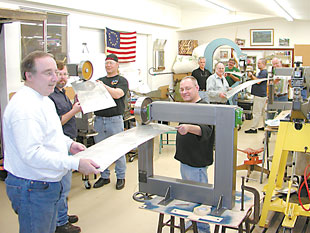
Workshop participants in the 4-day Metalworking
Intensive refine their skills on the English Wheel.

All of our Metalworking Intensives cover a different fundamental training topic each day, and each day is a stand-alone intensive study and practice on that technique. You may attend all four days, or any combination of days that are areas you wish to study. However, priority is given to participants who plan to attend all four days.

Common topics -- such as planishing, metal finishing, annealing, work-hardening, heat-treating, patterns, and layout - will be covered in context on each of the four days.

A packet of special workshop preparation materials is sent to you three weeks prior to the workshop. It contains three videos, and many pages of printed material for your study prior to workshop attendance. This packet is available only to those who sign up for all four days of the workshop (and if available separately would be worth $200). If you are attending only part of a workshop, please contact us regarding what advance-study materials you will need.

Please note: Kent's tricky techniques for teaching include conundrums, brick-walls, and brain twisters. You will learn to solve problems and to think like a real metal-man -- by overcoming obstacles, and by using your bucket of grey cells. Gold star, anyone? It goes on your permanent record, you know.


Metalworking Fundamentals

Oct 11 - 14, 2013

This course is specially designed for those with limited experience in working sheet metal (shaping, repair, fab) and for those who want to learn more about metalworking tools in the shop environment. We will cover layout basics, cutting metal with snips, shears, and machines, followed by files, filing, and metal sanding. You will learn hand skills used for stretching (to make hollows and curves) and shrinking (to take down bumps and make shapes). Annealing and joining will also be covered in detail. Learn about the seven main machines for working sheet metal: shears, brakes, English wheels, air power hammers, Pullmax, shrinker/stretchers, and the bead roller.

Day 1 - Tools & Hand-Forming Sheet Metals

This class begins with a show-and-tell of the many different hand tools used for straightening and fabricating sheet metal bodywork. Demonstrations and practice of straightening and fabrication follow, using hammers, dollies, slappers, spoons, and anvils. Next we cover planishing, which is followed by a discussion on metal finishing with files and sanding. Students are given projects for their own practice of these methods. Students will learn to form sheet metal into complex shapes, anneal the work-hardened metal, and cut and trim the metal. The oxy-acetylene torch will be introduced, along with proper setting and safety measures. Flow forming for hollow and reverse shapes will also be covered.

Day 2 - The basics of Shrinking and Stretching

Students continue with more hand tools, learning to stretch and shrink metal using the same tools. Cutting, shearing, and proper deburring procedures will be practiced. An introduction to paper patterns and layout will help students understand how to analyze solid geometry, and how to divide problems into bite-sized chunks. There will also be practice using seven different shrinking machines to make several compound shapes.

Day 3 - Welding, Brazing & Soldering

Welding, brazing, and soldering of aluminum sheet will be the main focus, with further emphasis on the oxy-acetylene torch. Flange joints, butt joints, radius joints, and lap joints will be covered in detail. Several hours of handson practice will be required. 99% of students learn to make a good weld on aluminum in this class.

Day 4 - Intro to Metal Forming Machines

The day will begin with a thorough 2-hour module on the bead-roller, or “jenny” (rotary) machine. Die design, application, and problem-solving will be the key elements. Pre-stretching and other methods of solving panel-distortion problems will be covered. We will then explore the English Wheel, with students learning proper setup, clearance, pressures, tracking patterns, and both hollow and reverse shapes. Students will have two hours of hands-on practice, problem solving, and getting used to the flow of the machine. The Pullmax and the Air Power Hammer are also introduced and used during this four-day course.

Note: Students are given demonstrations, lectures, and show-and-tell, and then hours of hands-on practice. All students are expected to participate fully in all phases of the class instruction. Mere spectating is not permitted!

Cost: $375 per day (includes breakfast, lunch, materials & supplies).

Pre-req: Sincere interest in metalworking and a willingness to get your hands dirty. This workshop is for all skill levels.


Back to Schedule Register Now


Have you already been to The Metalworking Fundamentals? Want some more challenge, inspiration, and intimidation? Read On...

4-Day Metalworking Intensive

Oct 25 - 27, 2013

Whether you’ve only been doing metalwork for a short time, or you’ve been doing it for decades, this workshop will hone your skills! This course gives you a unique opportunity to be in a production metalworking environment where you’ll meet other metal enthusiasts, while taking your skills to the next level. This workshop is tailored to meet the needs of each group of participants. For that reason, the information and pace taught can vary depending on the background, experience level, and interests of each group.

Day 1 – Stretching Tools & Methods

Fundamental concepts of metallurgy and metal behavior are introduced so that the student can become familiar with (and can anticipate the response of) metal to certain forces. Annealing, work hardening, and heat-treating are covered in the context of both making and repairing parts. Many approaches to stretching problems are covered, enabling the student to easily create his own solutions to achieve many shapes and forms. You will understand how to avoid excessive thinning while achieving the fastest stretch possible. The Air Power Hammer and other rapid forming tools are used to support hand working. Applications: bowls, hollows, reverses, fairings, saddles, and curved flanges.

Day 2 – Shrinking Tools & Methods

Using the Stretching class as a springboard, the Shrinking class stresses the underlying relationship of the duality of metal, and how heat and cold, soft and hard, and thick and thin affect the ability of the metal to take new shapes. Kent has defined 14 separate shrinking methods (most classes will cover nine or more methods). Applications: hollow shapes, curved flanges, and making repairs and adjustments.

Day 3 – Aluminum Gas Welding

Applications on non-structural parts and alloys are given in context. Using traditional, proven teaching methods, each student is expected to make a good weld in 6 hrs., just as the aircraft factories trained their welders years ago. Torch and tip selection, pressure regulator settings, fluxes, and fillers are covered in detail. Joint design, geometry, distortion, and applications are demonstrated and detailed. Students are given a basic joint to master, and when done they are encouraged to move on to a more difficult joint. Two hours of instruction, critiques, and demonstration, with 6 hours of student hands-on practice.

Day 4 – Using Forming & Shaping Machines

The English Wheel, Pullmax, and Air Shaping Hammer are shown in contrast to (and in support of) each other using demonstrations and projects. Time will be allowed for the student to become familiar with each machine. Personal projects are helpful for this segment, so if you have a project you’re working on, bring it along.

Cost: $375 per day (includes breakfast, lunch, materials & supplies).

Pre-req: We highly recommend attending "The Original" 4-day Metalworking Intensive "Metalworking Fundamentals" first. However, if you have a minimum of 2-3 years of metalworking experience please contact us and we will be happy to discuss which course is best for your skill level.


Back to Schedule Register Now


Gas Welding Aluminum & Steel

Location: San Francisco, CA
June 27 - 28, 2013

In many cases, welding thin sheet metal is more appropriately done with the oxy-acetylene torch. It’s cheaper and faster, and often has less distortion. This hands-on course begins with learning to safely set up bottles, regulators, and torch, with leak testing. The first day will introduce you to welding mild steel sheet in 18-gauge and 20-gauge thicknesses. For more advanced students, tube joints will be available, along with some 4130 chromoly alloy. Filler metals, joint designs, tip selection, and torch options will also be covered.

The second day will cover welding the 3003 aluminum alloy with flange welds in .050” thickness, with butt joints available later on for the more advanced welders. 5052 and 6061 will also be discussed, and aluminum brazing and soldering will be demonstrated, along with their proper applications. Cleanliness, regulator pressure settings, tip choices, flux choices and proper flux mixing will be covered, along with clean-up for primer and paint coats. Distortion remedies and planishing to a polished finish will be included.

Your instructor, Kent White, will guide your hands and intellects, so you get the feel for welding with the humble torch. Some interesting demos including welding with cutting torch, and writing your name in the air may be incorporated.

** Students are asked to bring their own eyewear and safety gear, and may bring their own torches, as well. Please let us know if you are in need of eyewear or safety gear for the workshop and we will do our best to accommodate you.

Cost: $325. per day

Pre-req: Sincere interest in metalworking / torch welding


Back to Schedule Register Now


Air Hammer Intensive

Location: San Francisco, CA
June 29 - 30, 2013

Today, there are “rivet gun” air hammers sold by every tool company that sells metalworking tools. Which is the best? How does it work? Can you really shrink 14-gauge steel with one? Or shrink 1/8” thick aluminum? Why do I need a class on air hammers?

Your instructor, Kent White, has been using and developing Air Power Hammers since 1987, and has used them in hundreds of restoration and fabrication projects. He is familiar with the hand-held planishers: Water Vliet, Milwaukee Electric, Chicago Pneumatic, Seiden, and the best one, the Ram’s Head. And although there are many “air hammers” on the market today, when TM Technologies first developed there were very few, and they were all “planishing" hammers (designed primarily to lightly shape or smooth metal only).This course focuses on using air "power" hammers to rapidly shape and shrink metal — even 10- or 12-gauge mild steel.

This class will cover making and repairing many different compound shapes: stretching domes, or hollow shapes, stretching reverses very rapidly, curving flanges, making radius bends for rocker panels, shrinking the edges of hollow shapes, raising, bouging, stretching in the middle of a panel, and hot shrinking (and even a few tips for planishing with these machines)

What metals are you working with? Mild steel, stainless, aluminum, bronze? If you have a shape you are working on, or metal you would like to try working with, bring it along and see for yourself how you can accomplish more than you realize, in less time than you thought possible. And, as an added bonus, you will still be able to use your arm at the end of the day!

Cost: $325. per day

Pre-req: Some basic metalworking & shop experience (ability to handle tools / machines) is needed. If you are unsure if your skill level matches the course, please contact us and we'll be happy to assist you.


Back to Schedule Register Now


Working with Soft Metals (Aluminum & Copper)

Techniques for Fabrication, Repair, Gas Welding, Brazing & Soldering
Location: Nevada City, CA

July 12 - 14, 2013

Have you wanted to work with aluminum or copper but were daunted by making the jump from steel? Have you attempted to learn to gas weld soft metals but found it too frustrating or challenging? Working with the soft metals isn’t nearly as difficult to master as you might think or have been told — but you need to know certain tips and techniques. This 4-day class is designed to give you complete knowledge of the basics of working soft sheet for automotive, aircraft, motorcycle, or sculpture, and art metal.

This workshop covers several techniques for cutting sheet, as well as hand- and machine-forming. Hot-working methods covered include annealing, shrinking, welding, brazing, and soldering. Along with these basics, students learn metal shaping,  tips and tricks for shrinking and stretching, plus planishing, and metal finishing.

Students will be taught how to make paper patterns and then transfer them to a 3D form, buck, or mockup, then break down that large shape into smaller workable shapes. You will then learn to make those shapes in metal using a variety of hand tools and machines. After roughing in the shape by stretching and shrinking, you will carefully define the fit of the part by smoothing and doing more refined work. Finally, by planishing and doing little adjustments in the shape, you will learn how to make the part fit. Once this is accomplished, you will trim and tack weld, finally joining them into a good shape that is filed and sanded.

Making hems and wired edges rounds out your experience, giving you a complete experience in all the steps, from first idea to final physical component.

If you are currently working on a project you are having difficulty with, you are welcome to bring it with you to work on in class, or to get advice and help on how to proceed with your project.


Cost: $375 per day.  Price includes breakfast and lunch, advance study materials, and all class materials and supplies. 

Pre-req: Sincere interest in metalworking. Some knowledge of basic shop tools is helpful (although we’ve had students who’ve never used tools). This workshop is for all skill levels.


Back to Schedule Register Now


Fabricating Parts with Metal Shaping Machines

Location: San Francisco, CA
Sep 27 - 30, 2013

Do you want to make a part for your project? Car, boat, airplane, motorcycle, or sculpture? Do you want to learn how to lay it out and how to approach constructing it?  This course gives you the opportunity to learn some fabrication skills at the same time you are learning or refining some machine skills.

Days One & Two will  focus on the Pullmax and English Wheel and their role in shaping parts. Two Pullmax machines will be set up for shearing, nibbling, and shrinking, as well as bead and joggle forming. The English Wheel is a deceptively simple stretching machine, that can be a help or hinderance depending on how you use it. We will begin with proper setup and adjustment, and making correct passes and tracking patterns. Then we will focus on getting the shapes you are looking for, plus tips for getting parts that truly fit.

On days Three & Four students will learn to quickly and accurately shape complex parts using the Air Power Hammer (instead of doing a ton of arm work). We will stretch, shrink, contour, and planish, as well as make complex parts such as hollows, reverses, and compound shapes on this rapid-shaping machine.

If you want to take the class, but have no particular project at the moment, Kent will be bringing along some bucks you can choose from (a 250 Testa Rossa hood blister or head rest fairing, or a wheel fairing for a GeeBee or Cessna 172. Or maybe making body parts for a mini 427 Cobra body). This class is designed for your success in fabricating parts using the most popular machines available today. Join in and have some great fun!

Cost: $350 per day

Pre-req: Metalworking Fundamentals or The 4-day Metaworking Intensive, or the equivilant experience is highly recommended. If you are unsure if your skill level matches the course, please contact us and we'll be happy to assist you.


Back to Schedule Register Now


Mastering the Torch
Welding, Brazing & Soldering


Nov 8 - 11, 2013

Here is your opportunity to learn how to join 5 different common metals 3 different ways, and how to apply this to fabrication and repairs. If you have been wanting to learn the advantages of torch welding (versatility, cost, efficiency, control), or if you are just wanting to improve your welding, brazing and soldering skills, this course is for you.

Day 1 - Torch Basics & Soldering steel, aluminum, stainless, copper, and brass.

We begin the first day with setting up the torch, regulators, and going over safety. Students then go on to define soldering and the temperatures involved. We experiment with cleaning the metals, choosing solders and fluxes, and practicing soldering techniques. Joint designs are then compared, along with tensile strengths and hardnesses. Soldering for repairs, constructions and fabrication are covered in detail, and you will learn to join the different metals to each other and to themselves. Students are required to participate in several hours of hands-on practice.

Day 2 - Brazing steel, copper, aluminum, brass, 4130, and stainless.

We will discuss working temperatures, tensile strengths, and fluxes and fillers. We will distinguish clearly between soldering and brazing. Misinformation about "hot metal" joining is discussed thoroughly. Students will learn proper cleaning and joint prep, along with the techniques for setting the torch and applying different brazes. Several hours of hands-on practice is required of all students.

Day 3 - Welding steel, 4130, aluminum, and copper.

Students will learn the difference between welding, brazing, and soldering. We will use various joint designs and discuss pro's and con's of each. Students are expected to learn tensile strength variations between the methods, and several hours of student practice is required.

Day 4 - Practice makes perfect.

Since the amount of methods covered on previous days will require many hours of practice, this last day will make a big difference in your skill level. Students will practice more on the different techniques and correct any deficiencies. We will also cover joining techniques applicable for chrome plating.

Cost: $375 per day (includes breakfast, lunch, materials & supplies).

Pre-req: Sincere interest and basic metalworking skills. (Metalworking Fundamentals is NOT a pre-requisite for this class).

Back to Schedule Register Now


Shaping Sheet Metal for Cars, Bikes, Airplanes, and Sculpture

Location: San Antonio, TX
Tentative Dec 5 - 7, 2013

Are you interested in learning metal shaping techniques for compound contours on airplanes, autos, motorcycles, or sculpture? We are excited to be offering a new three-day class at a very unique fabrication and art metal facility in San Antonio. This course will cover using the Pullmax, English Wheel, and Air Power Hammer for making compound shapes in aluminum alloys and mild steel (and copper or bronze if students are interested in these metals). You will learn how to lay out the parts, cut the blanks, and then shape the individual parts to make the whole composition. Lectures, demonstrations, and hands-on practice will also cover pattern work, mock-ups, layout, annealing, stretching, shrinking, hand tools, and planishing. The facility for this class is conveniently located just minutes from the San Antonio airport. Please call for more details: 530-292-3506

Cost: $350 per day

Pre-req: Metalworking Fundamentals and/or some basic metalworking knowledge is recommended. If you are unsure if your skill level matches the course, please contact us and we'll be happy to assist you.


Back to Schedule Register Now


Alaska Workshops

Repairs, Fabrication, & Gas Welding
Location: Anchorage, Alaska


We are happy to announce that we will be offering two Alaska Workshops this year. Our facility for this location is Bob's Services in Anchorage, adjacent to Ted Steven's Airport. We have arranged the workshop dates around the 2013 Great Alaska Aviation Gathering (May 4 & 5). We expect these two workshops to fill up, so please let us know right away if you are interested. We will also have a booth at the show, and Kent will be doing one presentation at the show conference. Please be sure to make your hotel / motel reservations soon as finding rooms may be more of a challenge during that week.

Steel Workshop
Location: Anchorage, Alaska


The steel workshop will include torch welding, brazing, soldering and hot working the first day, and fabrication and repair techniques the second day.

Repairs include: oil cans, hail dents, barbed wire and ammo damage, and distortion from collision.

Solutions include: annealing and hot working using the oxy-acetylene torch. Also rivet guns, flow forming, slappers, hammers, dollies, spoons and an Air Power Hammer that shrinks while it straightens.

Fabrication includes: making replacement panels and patch panels, pattern work, cutting, bending, and making contours by stretching and shrinking, and using form blocks and simple shop-made tooling.

We LIKE projects! Yes, you may bring a project, but check with Kent first so your choice works out best for you.

Cost is $300 per day, covering any needed printed prep materials, and shop materials. Aluminum Workshop
Location: Anchorage, Alaska


Day 1:  Five main aluminum alloys will be discussed, along with the proper methods and tools to repair them. Learn how common body work tools can be adapted and used properly, as well as rivet guns, shot bags, and dead blow hammers. Use an Air Power Hammer that shrinks while it straightens damage. Accurate annealing temperatures and methods will be taught, along with both hot and cold working techniques.

Day 2:  Welding, brazing, and soldering will be demonstrated and then practiced by all students. Learn the appropriate hot joining method for the problems you face, and the drawbacks of certain products and techniques.

Day 3:  Fabrication methods, starting with various approaches to solving similar problems. Learn how to pattern your part accurately, and then cut it out and I will teach you how to make the shape that you need. Learn about working with flanges and angles, cowl lips and fairings. Wood forms and flow forming can make your work faster, more accurate, and easier.

We LIKE projects! Yes, you may bring a project, but check with Kent first so your choice works out best for you.

Cost is $300 per day, covering any needed printed prep materials, and shop materials.


Back to Schedule Register Now


Switzerland/Europe Workshops

May 30 - June 2
Repairs, Fabrication, & Gas Welding
Location: Ruti, Switzerland


If you have any questions or you would like more detailed information please contact us at 530-292-3506. We can also be reached by email at workshops@tinmantech.com.


Back to Schedule Register Now


We Also Offer


Workshops at your Location

Do you have a crew that needs to increase their efficiency or improve their metal working, welding, or forming machine skills? Kent can design a specific teaching program to suit your needs, on your equipment, with your group at your site. You only need to list what tools and equipment you have and what you want to accomplish. Past programs have included instruction on the English wheel, Air Power Hammer, power shrinker, and aluminum gas welding. Other courses have covered aircraft sheet metal fabrication and repairs; fuel tank construction and repair; autobody fabrication, repair, and restoration; and general metal behavior for parts fabrication. He has also given small group and private instruction for automotive, aircraft, motorcycle, and art metal groups and academic programs. Kent has done corporate consultations for BFGoodrich, Delta Airlines, UPS in Shannon, Ireland, FedEx, Precor, and others. His Aero Metal Workshops receive FAA IA Course Credit as Refresher Training Courses . Off-site workshops range from 2-5 days, and the cost is based on number of days, travel and expenses, and costs for shipping equipment or tools if needed. Please call or email us at workshops@tinmantech.com for details.


Back to Schedule


TIG Welding
Aluminum, Stainless & Titanium

Please call or email us at workshops@tinmantech.com for information.


Back to Schedule Register Now


Working with Forming Machines: The English Wheel, Air Power Hammer, Pullmax & More

This workshop will focus on the broad range of Metal Shaping Machines and their proper use. Although each day focuses on working with specific machines, you will find that we will discuss and compare a variety of machines each day.

Day 1 – The Air Power Hammer

Many people instinctively refer to all “air hammers” as “planishing” hammers while neglecting the forming operations which must precede planishing. Learn how an Air Power Hammer can help you quickly and accurately rough-in shapes, shrink, stretch, and perform other forming operations (like straightening out crumpled nosebowls) in addition to planishing. We will explore how to make reverses, fairings, and saddle shapes, how to flange and curve edges, and how to get the most out of this machine.

Day 2 – English Wheel

We start with a little history, and then we get into the set-up and geometry of this machine. The Wheel is deceptively simple. To the casual observer it appears as if you are just rolling a piece of metal back and forth — how hard could that be? But to use this machine correctly and efficiently, there are a lot of little tricks that add up to big rewards. Learn when you should use the wheel and when to choose another tool, how to make passes correctly, how to get the shape you’re looking for, how to make those welds disappear, and how to get a beautiful mirror finish.

Day 3 – Shrinking Machines, Pullmax, and Flow-Forming

A number of machines have been used in the sheet metal industry for decades — that you’ll find incredibly useful including various shrinker-stretchers, brakes, and electric reciprocating (Pullmax) machines. We’ll go over the pros and cons of the various machines, and strategies for getting the most out of each, including basic maintenance, as well as techniques for shrinking, stretching, edge turning, flanging, beading, simple ways to create louvers, and make reverses. Ever tried Flow-Forming? It’s an extremely fast, inexpensive method you can use to speed up specific types of tedious shaping jobs normally done by hand.

Day 4 – Putting it all together

Day four of this workshop is your opportunity to test the skills you have just learned — using the tools and forming machines from the first three days of class. You can bring a part that you would like to work on, or bring an idea of something you would like to try making. This is also your opportunity to work with Kent one-on-one with any machines you are having difficulty with, and to share ideas with others in the class on solving fabrication challenges.

Cost: $375 per day (includes breakfast, lunch, materials & supplies).

Pre-req: An understanding of shop environment, hand tools, and basic processes of measuring, marking, and cutting sheet metal. (Metalworking Fundamentals is NOT a pre-requisite for this class).

Back to Schedule Register Now


Aero Metal: Fab, Welding, & Repair

The three primary aviation metals are aluminum, 4130 chromemoly, and stainless. This class will focus mostly on aluminum, from low-strength alloys 1100 and 3003, to medium-strength 5052 and 6061, and high-strength 2024. The class will learn the differences between these alloys, their tempers from soft to hard, and the various thicknesses. 

 Over the four days, class projects will include: making lightening holes for ribs and fuel tanks, making louvers, and working flat sheet into shapes such as wing root fairings, wheel pants, and wing tips. Students will have many hours to learn riveting, welding, brazing, and soldering. Some damaged parts will also be on hand for practice in making repairs, enabling students to learn hand skills such as annealing, shrinking, planishing, and metal finishing. 

There will also be practice time using metal shaping machinery such as the English wheel, the air power hammer, the bead roller, pedal shear, leaf brake, and the flow- forming system. 

Students will be asked to respect the shop environment and the equipment, as this special teaching venue is also a production aircraft shop, with tools that are in very good condition. 

Some shop skills will be necessary, such as laying out parts on sheet stock, organizing a small job, reading a tape measure, and working to some degree of accuracy. Some stainless and 4130 forming and repair instruction will also be included.

Workshop location: This special workshop is hosted by AirMotive Specialties of Salinas, CA, one of the top P-51 building and restoration shops in the country today. Classes will be held in their hangar / shop at the Salinas, CA airport. 

Pre-requisite: Basic understanding of (and preferably some experience with) shrinking, stretching, forming, and shaping. Recommended: Metalworking Fundamentals (or 4-Day Intensive, or Aluminum Intensive) or equivalent. 

Cost: $425 per day.  Includes all materials (sheet metals, machines, and tools), and full breakfast and lunch daily. Call for details on optional lodging/meals discount package.


Back to Schedule Register Now


Autobody: Rust Repair & Patch Panels

Rusted steel body panels can be a nightmare for restorers or customizers – but simply grinding the paint off and filling the holes with Brillo pads and Bondo are not the best methods for making repairs! Kent has spent years doing rust repairs on many high-end cars, as well as many plain old street cars, and this class will cover several methods for making sound, durable repairs on those rusted-out areas. Be prepared to get filthy dirty.

First, cutting out the rusted areas will involve several distinct methods, and you will find the best one for your own situation. (Did you know that a simple welding torch can cut steel very well?) Being able to “see” how far the rust has spread is very important, and you will learn a simple method for doing this quite effectively.

Making the repair panels is the next step. It’s surprising how organized this can be. Paper and cardboard patterns are very helpful to start the process, and a few hand tools can go a long way toward making simple panels. You will learn these techniques, and how to join your panels by brazing, soldering, and welding. We’ll also introduce adhesives that can be very beneficial for these repairs.

Third, you will also learn the chemistry behind rust removal and prevention, with coatings, primers, and top coats that can go a long way toward preventing rust from returning. Kent has never had a car returned to his shop for additional rust repairs, and his work has entailed replacing complete floors, quarter panels, hoods, roofs, and doors.

Workshop location: Our host for this workshop is Grace Body Shop, one of San Francisco’s premier shops for restoration, specialty, custom, collision, and detail. Grace specializes in Audi, BMW, Mercedes, Maserati, Lamborghini, hotrods, antique equipment including fire engines, and unique architectural projects.

Pre-requisite: Open to all skill levels. Fundamental understanding of metalworking basics, and general knowledge of the metal shop environment is recommended (common hand tools, measuring, marking and cutting metal, etc.).

Cost: $350 per day.  Price includes advance study materials, and all class materials (including sheet metal, and welding supplies).


Back to Schedule Register Now


Aluminum Intensive
Gas Welding, Brazing, Soldering, Fabrication & Repair

Have you wanted to work with aluminum but were daunted by making the jump from steel or other metals? Have you attempted to learn to gas weld aluminum but found it too frustrating or challenging? Aluminum isn’t nearly as difficult to master as you might think or have been told — but you need to know certain tips and techniques. This 4-day class is designed to give you complete knowledge of the basics of working aluminum sheet for automotive, aircraft, motorcycle, or sculpture.

Aluminum is made into a variety of alloys and is widely used in various thicknesses and hardnesses. This workshop covers several techniques for cutting aluminum sheet, as well as hand- and machine-forming four popular alloys: 1100, 3003, 5052, and 6061. Hot-working methods covered include annealing, shrinking, welding, brazing, and soldering. Along with these basics, students learn metal shaping, planishing, and metal finishing.

Students learn to make paper patterns and then transfer them to a 3D form, buck, or mockup, then break down that large shape into small workable shapes. You’ll then learn to make those shapes in metal using a variety of hand tools and machines. After roughing in the shape by stretching and shrinking, you will carefully define the fit of the part by smoothing and doing more refined work. Finally, by planishing and doing little adjustments in the shape, the part will fit. Once the parts all fit, students will trim and tack weld them, finally joining them into a good shape that is filed and sanded.

Making hems and wired edges rounds out your experience, giving you a complete experience in all the steps, from first idea to final physical component.

If you are currently working on an aluminum project you are having difficulty with, you are welcome to bring it with you.

Pre-requisite: Sincere interest in metalworking. Some knowledge of basic shop tools is helpful (although we’ve had students who’ve never used tools). This workshop is for all skill levels.

Cost: $375 per day.  Price includes breakfast and lunch, advance study materials, and all class materials and supplies.


Back to Schedule Register Now


Steelworking Intensive


For those of you who are into automotive restoration as a profession or a hobby will be right at home with us for this workshop. Last year a customer brought with him the front fender to his 1958 Desoto which was damaged around the front headlight brawl when a patch wrongly welded in. The students helped as Kent showed them how to replace the entire front section and fit the patch to the headlights with nothing more than a few hand tools and a torch. After a few hours the seamless patch was finished! Car, Motorcycle, Air Plane or Boat, bring difficult part and let Kent show you how to get started!

Day 1 - Methods for repairs for rust and crash damage

Making rapid tooling for repair panel fabrication, and repairing damaged panels starts this 4 day event. Kent's years of doing steel body restoration with some of the masters of Rollover Repairs will bring a lot of light to this topic. Add in annealing and hardening and this day is packed.

Day 2 - Stretching, Shrinking, and Planishing

There are some rapid ways to shrink steel panels right on the car, bike, or haybaler, so let's get with the program and move some metal. The same goes for stretching to flare some fenders. And then smoothing…why not pick up a Fender Planishing machine and let the machine do it…right on the car. Ever heard of or seen The Amazing Shrink Disc? Or the whirling whanging rubagizmo? I can show you how the Texas dustbowl Depression-era metalmen lifted out hail dents without a sound.

Day 3 - Gas Welding, Brazing and Soldering

What really works and what is a time-waster? Why braze? How can solder save time? Is that gas welding faster than TIG? Is the MIG welder really a manure spreader? We take a close look at what is appropriate for the task. Chrome? No sweat. I have made a bunch of steel stuff for chrome-plate, and have done serious repairs for chrome. How do you prep? I worked with a plating shop for years…prepping for Pebble Beach. Want to win? I did and I can show you some pretty effective methods.

Day 4 - Oil cans

Need I say any more? I once spent 3 MONTHS on a fancy 5-piece brass-trimmed Pierce Arrow hood that had gone saddle-back after a load of snow fell on it. Then some character sandblasted it. I sure learned a lot about shrinking…and oil cans. What are oil cans (oilcanes?)? How do they form? You will be surprised to learn what the truth is. And how easy it can be to send one packing. You will make them, and erase them by days' end. And, if you are a real pro and get through my obstacle course…we can do a class on Louvers.

Cost: $345 per day (includes breakfast, lunch, materials & supplies).

Pre-req: Sincere interest and basic metalworking skills. ("The Original" 4-Day Intensive is NOT a pre-requisite for this class).

Back to Schedule Register Now


Louvers, Flow Forming, and a Project -
Building a Grille Shell for a Pre-war Alfa Romeo


Day 1–Louver secrets

Kent has compiled a number of ways to make louvers quickly and accurately. He has a louver punch with a high-tech set of spring-loaded louver dies. Using these and four more ways, you will learn five methods of making louvers. From using a press and precision-machined dies, to making your own dies with no machining, to making louvers either free-hand or with very basic forms, you will become a Louver King.

Day 2–Flow Forming

We all use a mallet or hammer to form parts, but there is a faster way that is incredible. Join us to have some real rapid fun. Students will develop an understanding for the tooling and force required for making parts using this method. Several form blocks will be provided for the class, and students are welcome to bring projects.

Day 3 and 4 – Project Time!

Learn how to build a grille shell for a Pre-war Alfa Romeo from start to finish

Cost: $345 per day (includes breakfast, lunch, materials & supplies).

Pre-req: Sincere interest and basic metalworking skills. ("The Original" 4-Day Intensive is NOT a pre-requisite for this class).

Back to Schedule Register Now


Copperworking & Art Metal


We will begin by comparing copper to known/familiar metals, and then contrasting it by its working characteristics. Since this will be mostly for artists/artisans/sculptors our format will be less focused on structures and engineering and more on organic shapes. Because of the high cost of sheet copper our costs are higher, and the price must reflect this: $395 per day.

Day 1 - Patterns, Bucks, Mock-ups, and Maquettes

Learn to paper out a shape, transfer solids to flats, and make 3D solids from which to build. What is legal? How creative can we get? This will be "Paper Dolls 101" or "Crafts 206" - taking the idea and working it into a mockup.

Day 2 - Annealing, Shrinking, Stretching, Planishing

This is where the copper is laid out, blanked, and the shape is put into it. We will use hand tools, home made tools, and forming machines to work the sheet into some creative shapes. Annealing, hardening and hot work will be included for your benefit. Embossing and pressing will round out the day.

Day 3 - Tubing: measure, bend, cut, fit, weld/braze

The two types of tubing will be used to show how structures can be made strong with either one. Cutting and bending will surprise you, as I think I can show you unusual methods of bending you may not be aware of, bending tube of any kind. Welding and brazing will be introduced, and then continued on Day 4.

Day 4 - Welding, brazing & soldering, polishing, coloring, and patination

Joining copper (and brass and stainless) to each other can be a wonderful accent to a sculpture, as can patination. Once we learn to weld, braze, and solder this metal then we can think about the final color, and make choices based on weathering, location, or coating the finished piece. Commercial patinations will be used as well as home-brewed concoctions.

Cost: $395 per day (includes breakfast, lunch, materials & supplies).

Back to Schedule Register Now


Help Center
PHONE ORDERS:  530-292-3506  (9-5, M-F, PST)
24-hr FAX ORDERS:  530-292-3533
EMAIL ORDERS:  orders@tinmantech.com


TM Technologies, Manufacturers & Producers, Nevada City, CA